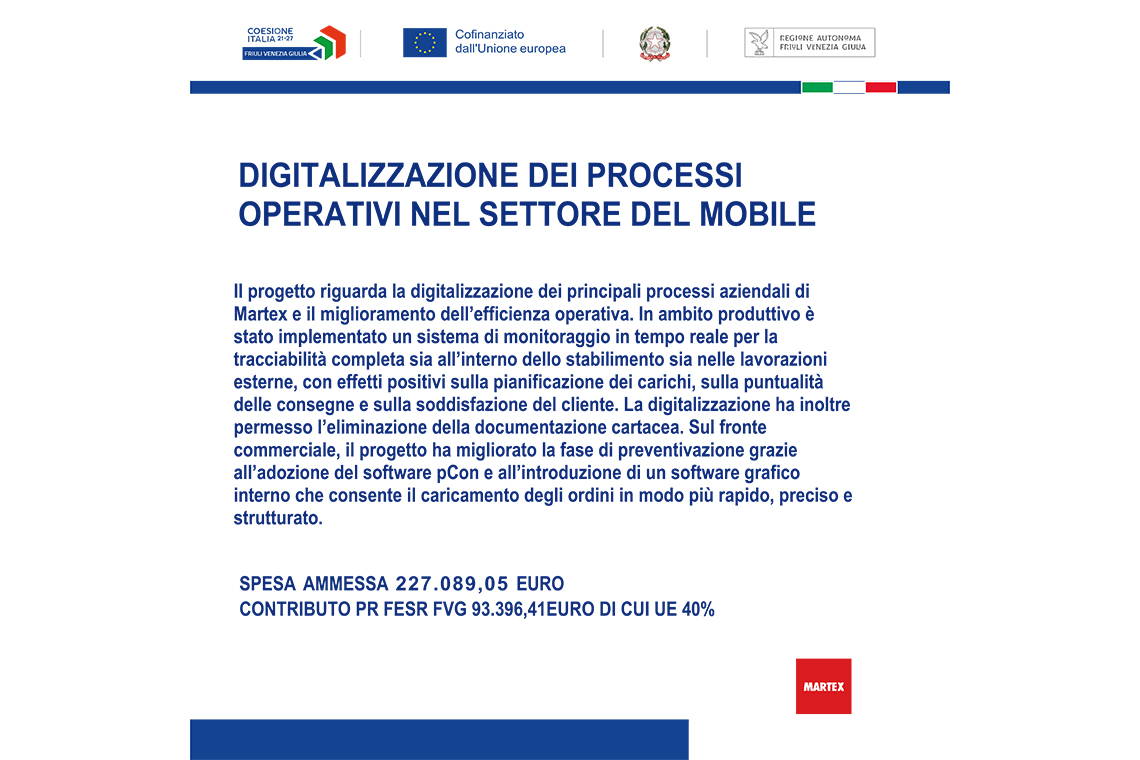
Martex took part in a regional call for proposals supporting the digitalization of business processes and was awarded funding for a major innovation project.
The initiative focuses on the integrated digitalization of production and commercial processes in the furniture sector, with the aim of improving operational efficiency, traceability, and data quality.
The project involves the entire company value chain, from order management to production and logistics, as well as commercial activities, strengthening Martex’s competitiveness in line with Industry 4.0 principles.
The project focuses on the integrated digitalization of Martex’s production and commercial processes through the implementation of advanced technological solutions aimed at improving operational efficiency, traceability, and the quality of company data.
The intervention involves the entire value chain, from order management to production and logistics, as well as commercial activities, enabling a more structured, high-performing, and data-driven management approach.
In the production area, a real-time monitoring system has been implemented to track the progress of manufacturing activities, allowing full traceability of each individual component both within the production facility and during external processing phases. This innovation enables more effective workload planning, a reduction in operational inefficiencies, and improved on-time delivery performance. At the same time, the digitalization of information flows makes it possible to eliminate paper-based factory documentation, increasing data reliability and reducing errors and processing times.
In addition, the project delivers a significant improvement in the quotation and order entry phase through the implementation of the pCon software and the introduction of dedicated graphic design software. These tools allow for more accurate product configuration, immediate visualization of proposed solutions, and faster and more precise sales order entry, fully aligned with production processes, resulting in benefits also from a commercial perspective.
The integration between commercial and production systems enables the automation of information flows from order entry to production, reducing manual activities and improving coordination among the different company departments.
Increased production efficiency, thanks to real-time monitoring of manufacturing progress and more accurate workload planning.
Improved traceability of products and production flows, with full visibility of the location, status, and processing stages of each individual component, both inside and outside the production facility.
Reduction of operational errors and management time, resulting from the elimination of paper-based factory documentation and the digitalization of information flows.
Improved delivery punctuality, achieved through more reliable scheduling and more precise management of production priorities.
Optimization of commercial activities, thanks to improvements in the quotation phase and the use of advanced graphic tools for product configuration.
Faster and more accurate sales order entry, with a significant reduction in manual activities and inconsistencies between the sales and production departments.
Better integration among company departments—particularly sales, production, and logistics—through the sharing of structured, real-time updated data.
Increased customer satisfaction, resulting from faster response times, clearer and more accurate offers, and greater delivery reliability.
Strengthened company competitiveness through more digital, efficient, and scalable processes, in line with Industry 4.0 principles.